From shopping data to environmental insight
Using smart data to reveal the environmental impact of food
For most people, the environmental impact of what they buy is hard to grasp or do anything about. This project set out to change that by using smart data to make the environmental consequences of everyday shopping visible to everyone.
Led by Professor Alexa Spence, researchers at the University of Nottingham developed a novel approach that combines supermarket transaction data with environmental metrics. This enables the calculation of the environmental impact of specific shopping baskets of individuals
As part of this work, the team developed an online food footprint calculator, where people can upload their Tesco Clubcard data and receive a personalised analysis of the environmental impact of their shopping.
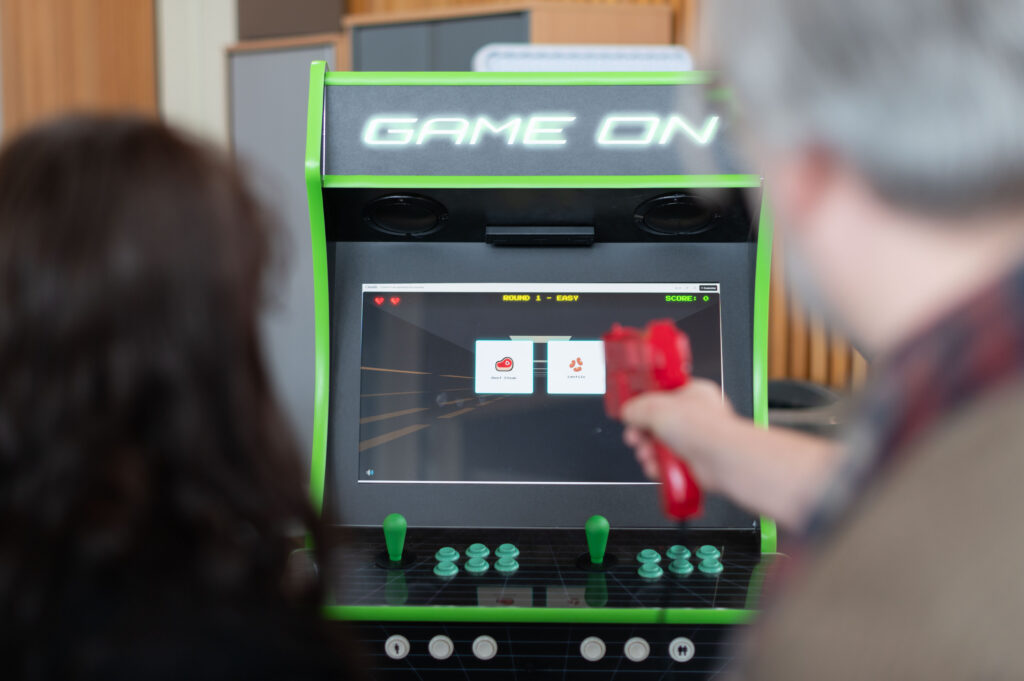
The team also developed an interactive arcade-style game, EcoBlaster 3000, available via the project website, which provides an engaging way for the public to explore the environmental impact of different food choices.
Turning shopping data into environmental insight
At the core of the project is the Environmental Food Purchasing Index (EFPI), a new metric designed to quantify the environmental footprint of grocery purchases at the individual or household level.
Built using tens of thousands of Tesco products, the EFPI translates purchasing data into four key environmental indicators:
- Greenhouse gas emissions
- Water stress
- Land use
- Chemical run-off
These are expressed through relatable, everyday equivalents such as kettles boiled, baths filled, and trees used. This makes complex data meaningful and actionable.
The EFPI can be adjusted to allow fair comparisons. For example, per person, per household, or over time. This creates a powerful tool for both researchers and organisations seeking to understand and reduce the environmental impact of food consumption.
From estimates to reality
A key innovation of this work is the use of store card data, voluntarily donated by participants, to analyse real purchasing behaviour.
This marks a significant move in how sustainable consumption is studied. Rather than relying on self-report surveys or generalised assumptions, the project demonstrates that smart data can reveal the environmental impact of what people actually buy – not what they think they buy.
This project demonstrates that smart data can reveal the environmental impact of what people actually buy – not what they think they buy.
A new approach combines supermarket data with environmental metrics to show the environmental impact of what people buy.
The research also showed that store card data plays a critical role in improving data quality. In associated surveys, a high level of fraudulent responses was detected. Transaction data enabled verification of genuine participants and provided new insights into bias and reliability in behavioural research.
Rethinking what ‘sustainable’ Means
The project uncovered important gaps in how people understand the environmental impact of food.
Participants tended to:
- Overestimate the impact of highly processed foods
- Underestimate the impact of water-intensive foods such as nuts
- Rely on broad food categories rather than product differences
This led to consistent underestimation of differences within categories, especially between meats. For example, the much higher emissions from beef compared to chicken were not widely recognised.
Encouragingly, when these misperceptions were corrected, participants reported intentions to change their behaviour – highlighting the potential of better information to drive more sustainable choices.
Building trust in data donation
The project also explored the ethical and practical challenges of using personal data for research.
could be the largest dataset of supermarket purchasing data voluntarily donated for academic research
It resulted in what the researchers think could be the largest dataset of supermarket purchasing data voluntarily donated for academic research. And also, one of the only datasets that matches this shopping data to survey data on perceptions; allowing perceptions and scientific estimates to be compared.
Findings show:
- Strong public willingness to contribute personal data for environmental research
- Persistent barriers related to access and usability
- The importance of transparency, control, and meaningful feedback
These insights informed the development of the CDat Food portal, which enables participants to securely share their data and receive personalised environmental feedback.
Making the invisible visible
This project demonstrates a fundamental shift in how we understand sustainable consumption.
For the first time, individuals can see the environmental impact of their own shopping behaviour – transforming sustainability from an abstract concept into something personal, measurable, and actionable.
By combining behavioural science, smart data, and new digital tools, this work provides a foundation for:
- More accurate research into real-world consumption
- Better targeted policy interventions
- Personalised tools that support sustainable choices at scale
In doing so, it shows how smart data can move us from awareness to action – helping people not just to care about sustainability, but to act on it.
Powered by SDR UK
This project demonstrates the value of SDR UK’s funding support, in this case via the SDR UK Accelerator programme. It enabled access to real shopping data, which was critical to delivering the research and developing tools such as the food footprint calculator.
The project has already led to further funding for continued research and dissemination, and supported the development of new partnerships with organisations including the Co-op and Databonds, providing ongoing access to data for future work
Smart Data Research UK would love to hear about your research!
Do you have a smart data case study to share? Contact our team at smartdataresearch@ukri.org to showcase your work.